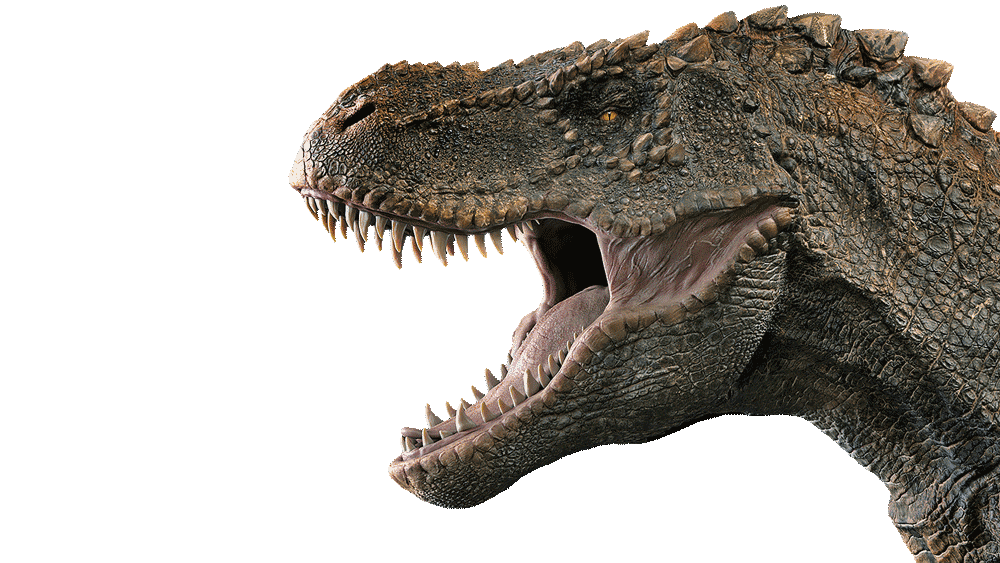
Tyrannosaurus is a genus of coelurosaurian theropod dinosaur. The species Tyrannosaurus rex (rex meaning "king" in Latin), often called T. rex or colloquially T-Rex, is one of the most well-represented of the large theropods.
It is derived from the Greek ἄλλος/allos ("different, other") and σαῦρος/sauros ("lizard / generic reptile"). The first fossil remains that could definitively be ascribed to this genus were described in 1877 by paleontologist Othniel Charles Marsh.
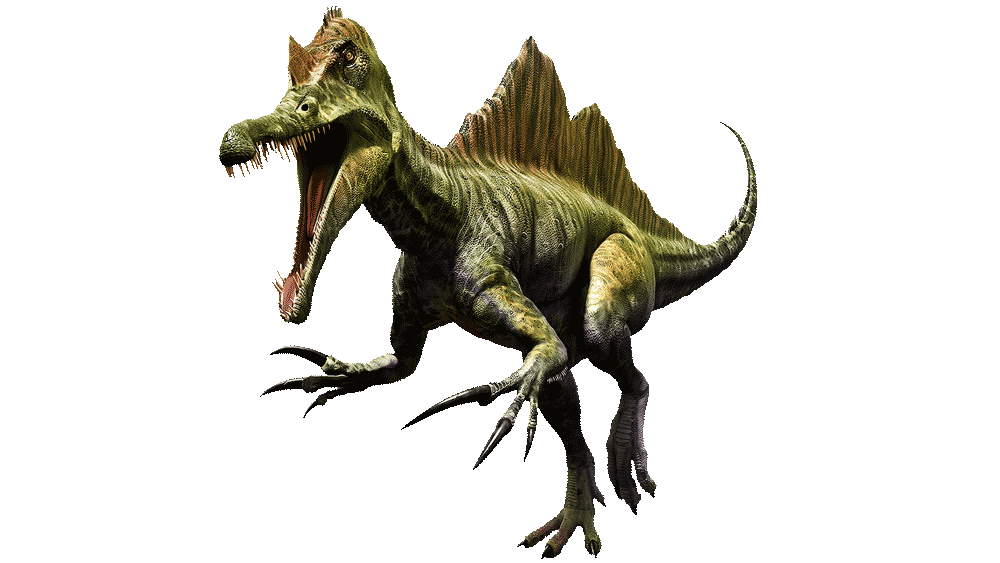
Spinosaurus (meaning "spine lizard") is a genus of theropod dinosaur that lived in what now is North Africa, during the upper Albian to upper Turonian stages of the Cretaceous period, about 112 to 93.5 million years ago.
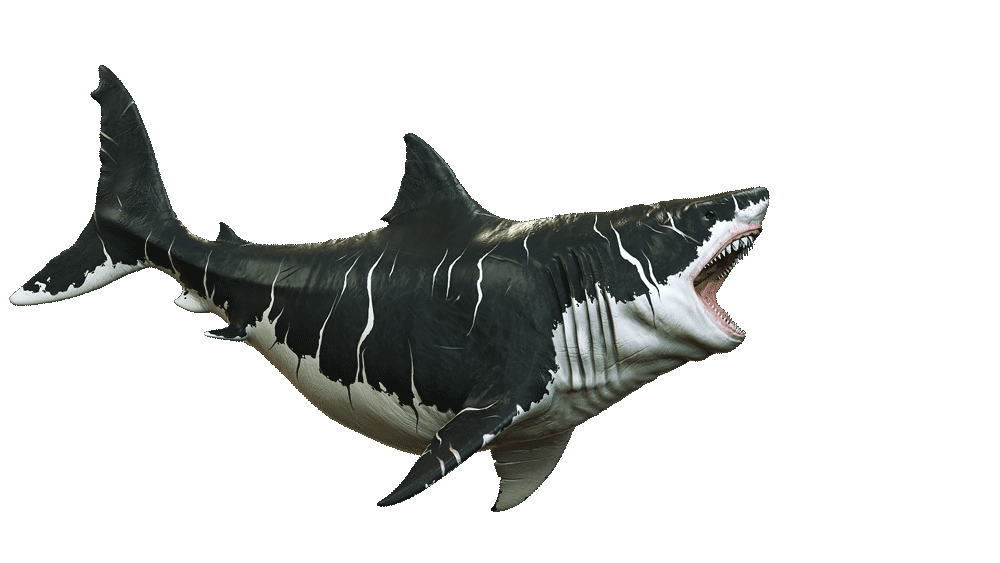
Megalodon (Carcharocles megalodon), meaning "big tooth", is an extinct species of shark that lived approximately 23 to 2.6 million years ago (mya), during the Early Miocene to the end of the Pliocene. It was formerly thought to be a member of the Lamnidae
family.
Triceratops is a genus of herbivorous ceratopsid dinosaur that first appeared during the late Maastrichtian stage of the late Cretaceous period, about 68 million years ago (mya) in what is now North America. It is one of the last known non-avian dinosaur
genera.
Tyrannosaurus[nb 1] is a genus of coelurosaurian theropod dinosaur. The species Tyrannosaurus rex (rex meaning "king" in Latin), often called T. rex or colloquially T-Rex, is one of the most well-represented of the large theropods.
Tyrannosaurus lived throughout what is now western North America, on what was then an island continent known as Laramidia. Tyrannosaurus had a much wider range than other tyrannosaurids.
Fossils
Fossils are found in a variety of rock formations dating to the Maastrichtian age of the upper Cretaceous Period, 68 to 66 million years ago. It was the last known member of the tyrannosaurids, and among the last non-avian dinosaurs to exist before the Cretaceous–Paleogene extinction event.
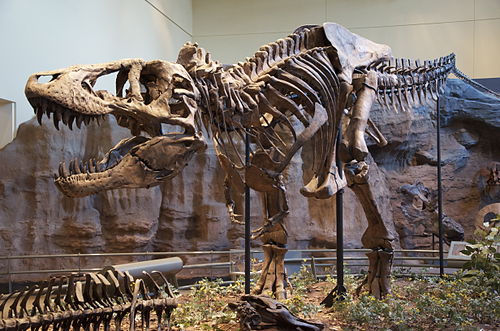
Reconstruction of the T. rex type specimen (CM 9380) at the Carnegie Museum of Natural History
Carnivore
Like other tyrannosaurids, Tyrannosaurus was a bipedal carnivore with a massive skull balanced by a long, heavy tail. Relative to its large and powerful hindlimbs, Tyrannosaurus forelimbs were short but unusually powerful for their size and had two clawed digits.
Tyrannosaurus rex was one of the largest land carnivores of all time; the largest complete specimen, located at the Field Museum of Natural History under the name FMNH PR2081 and nicknamed Sue, measured 12.3 meters (40 ft) long,[2] and was 3.66 meters (12 ft) tall at the hips,[3] and according to the most recent studies estimated to have weighed between 8.4 metric tons (9.3 short tons) to 14 metric tons (15.4 short tons) when alive.
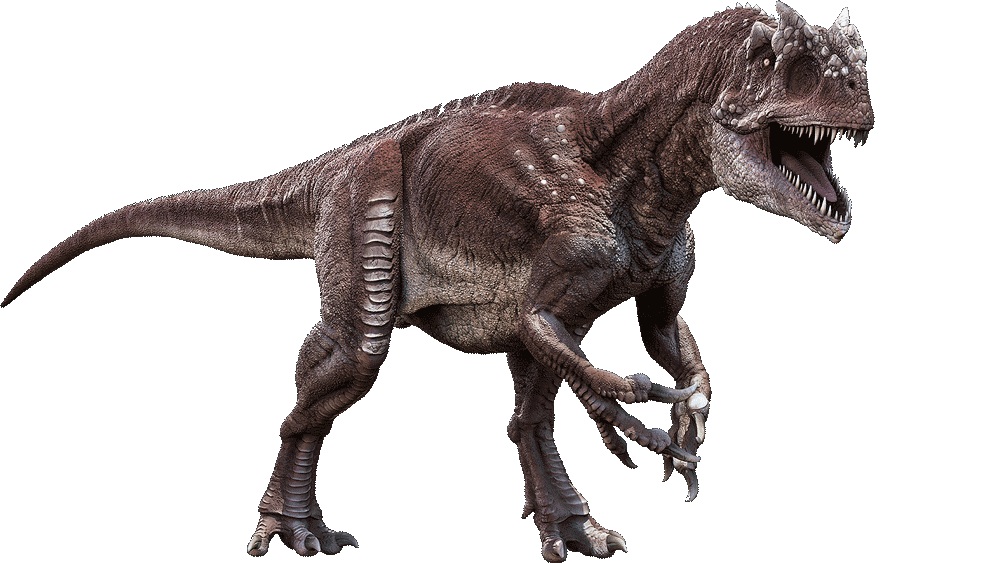
Allosaurus (/ˌæləˈsɔːrəs/[1][2]) is a genus of carnivorous theropod dinosaur that lived 155 to 150 million years ago during the late Jurassic period (Kimmeridgian to early Tithonian[3]). The name "Allosaurus" means "different lizard" alluding to its unique concave vertebrae (at the time of its discovery).
It is derived from the Greek ἄλλος/allos ("different, other") and σαῦρος/sauros ("lizard / generic reptile"). The first fossil remains that could definitively be ascribed to this genus were described in 1877 by paleontologist Othniel Charles Marsh.
Films
As one of the first well-known theropod dinosaurs, it has long attracted attention outside of paleontological circles. Indeed, it has been a top feature in several films and documentaries about prehistoric life.
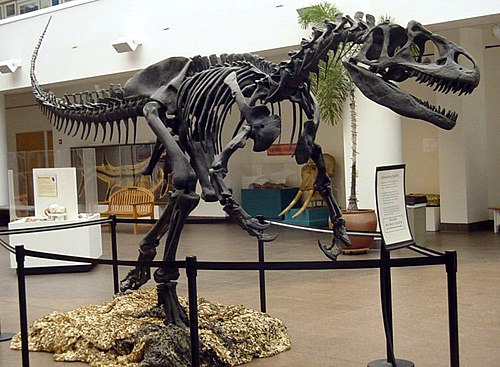
Mounted A. fragilis skeleton cast, San Diego Natural History Museum
Predator
Allosaurus was a large bipedal predator. Its skull was large and equipped with dozens of sharp, serrated teeth. It averaged 8.5 m (28 ft) in length, though fragmentary remains suggest it could have reached over 12 m (39 ft).
As the most abundant large predator in the Morrison Formation, Allosaurus was at the top of the food chain, probably preying on contemporaneous large herbivorous dinosaurs, and perhaps even other predators. Potential prey included ornithopods, stegosaurids, and sauropods.
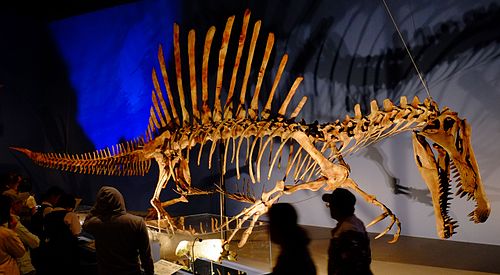
Spinosaurus (meaning "spine lizard") is a genus of theropod dinosaur that lived in what now is North Africa, during the upper Albian to upper Turonian stages of the Cretaceous period, about 112 to 93.5 million years ago. This genus was known first from Egyptian remains discovered in 1912 and described by German paleontologist Ernst Stromer in 1915.
The original remains were destroyed in World War II, but additional material has come to light in the early 21st century. It is unclear whether one or two species are represented in the fossils reported in the scientific literature. The best known species is S. aegyptiacus from Egypt, although a potential second species, S. maroccanus, has been recovered from Morocco.
Size
Since its discovery, Spinosaurus has been a contender for the longest and largest theropod dinosaur.[7] Both Friedrich von Huene in 1926[8] and Donald F. Glut in 1982 listed it as among the most massive theropods in their surveys, at 15 meters (49 ft) in length and upwards of 6 t (5.9 long tons; 6.6 short tons) in weight.[9] In 1988, Gregory Paul also listed it as the longest theropod at 15 meters (49 ft), but gave a lower mass estimate of 4 tonnes (3.9 long tons; 4.4 short tons).[10]
Reconstructed Spinosaurus skeleton in swimming posture
Naming
Two species of Spinosaurus have been named: Spinosaurus aegyptiacus (meaning "Egyptian spine lizard") and the disputed Spinosaurus maroccanus (meaning "Moroccan spine lizard").[18][19]
The first described remains of Spinosaurus were found and described in the early 20th century. In 1912, Richard Markgraf discovered a partial skeleton of a dinosaur in the Bahariya Formation of western Egypt. In 1915, German paleontologist Ernst Stromer published an article assigning the specimen to a new genus and species Spinosaurus aegyptiacus.[17][18]
Megalodon (Carcharocles megalodon), meaning "big tooth", is an extinct species of shark that lived approximately 23 to 2.6 million years ago (mya), during the Early Miocene to the end of the Pliocene.
It was formerly thought to be a member of the Lamnidae family, making it closely related to the great white shark (Carcharodon carcharias). However presently there is near unanimous consensus that it belongs to the extinct family Otodontidae, which diverged from the ancestry of the great white shark during the Early Cretaceous. Its genus placement is still debated, authors placing it in either Carcharocles, Megaselachus, Otodus, or Procarcharodon.
Evolution
While the earliest megalodon remains were reported from the Late Oligocene dated to around 28 million years ago (mya),[17][18] competing figures still exist as to when it evolved, such as 16 mya and 23 mya.[19] It is believed that megalodon became extinct around the end of the Pliocene, probably about 2.6 mya;[19][20] reported Pleistocene megalodon teeth, younger than 2.6 million years old, are considered to be unreliable claims.[20]
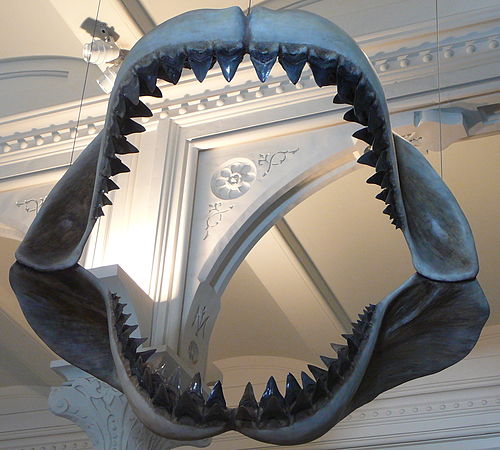
Model of megalodon jaws at the American Museum of Natural History
Appearance
One interpretation on how megalodon appeared was that it was a robust-looking shark, and may have had a similar build to the great white shark. The jaws may have been blunter and wider than the great white, and the fins would have also been similar in shape, though thicker due to its size. It may have had a pig-eyed appearance, in that it had small, deep-set eyes.
Another interpretation is that megalodon bore a similarity to the whale shark (Rhincodon typus) or the basking shark (Cetorhinus maximus). The tail fin would have been crescent-shaped, the anal fin and second dorsal fin would have been small, and there would have been a caudal keel present on either side of the tail fin (on the caudal peduncle).
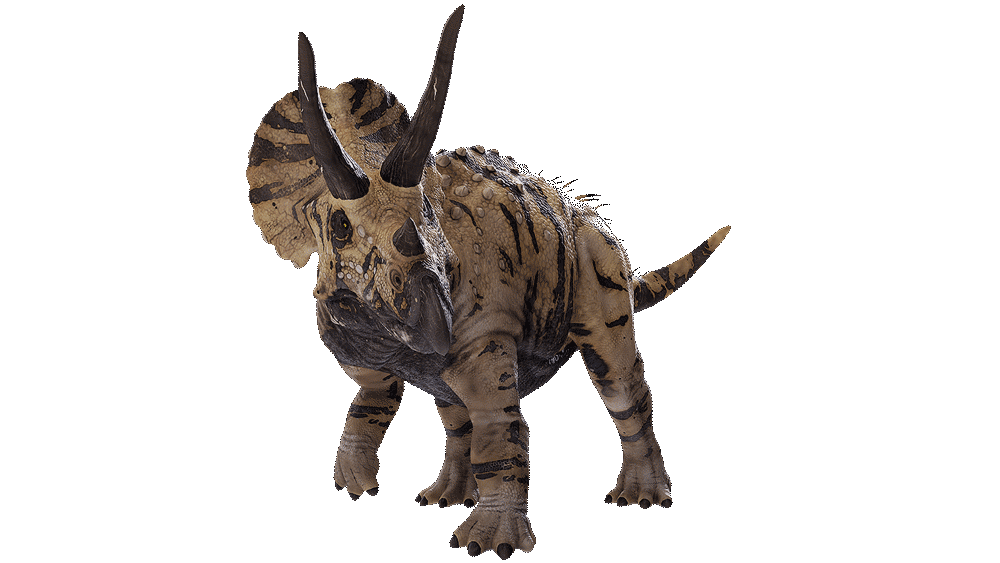
Triceratops is a genus of herbivorous ceratopsid dinosaur that first appeared during the late Maastrichtian stage of the late Cretaceous period, about 68 million years ago (mya) in what is now North America.
It is one of the last known non-avian dinosaur genera, and became extinct in the Cretaceous–Paleogene extinction event 66 million years ago.[1] The name Triceratops, which literally means "three-horned face", is derived from the Ancient Greek words τρί- (tri-) meaning "three", κέρας (kéras) meaning "horn", and ὤψ (ōps) meaning "face".[2][3]
First named
The first named specimen now attributed to Triceratops is a pair of brow horns attached to a skull roof, found near Denver, Colorado in the spring of 1887.[27] This specimen was sent to American paleontologist Othniel Charles Marsh, who believed that the formation from which it came dated from the Pliocene, and that the bones belonged to a particularly large and unusual bison, which he named Bison alticornis.
Skeletal mount of a T. prorsus specimen at the Natural History Museum of Los Angeles
Decades later
Within the first decades after Triceratops was described, various skulls were collected, which varied to a lesser or greater degree from the original Triceratops, named T. horridus by Marsh (from the Latin horridus; "rough, rugose", suggesting the roughened texture of those bones belonging to the type specimen, later identified as an aged individual).
With time, the idea that the differing skulls might be representative of individual variation within one (or two) species gained popularity. In 1986, Ostrom and Wellnhofer published a paper in which they proposed that there was only one species, Triceratops horridus.[37]
Family discovering exciting exhibit
The ISM - Interactive Science Musem has a long standing history of fun interactive ways of learning about science and history. The Museum features exhibits from Ancient Legends to Dinosaurs, Outer space, Robots and much more.
Exhiting events
The Musem gathers high praise and recognition internationally, and attracts several well known professors to lecture on subjects relevant to the sections of the Museum. You are destined to learn something new by following along these exhiting weekly lectures.
For all ages
We accomodate eager students to fresh preschoolers, and also have alot of senior visitors. In short, the museum is open for all and is sure to provide everyone with something suited for their interests and needs. The museum also has easy access for wheel
chairs and several toilets fr the needy.
Caféteria
If you're hungry you can always grab a bite in our interactive caféteria, it even features it's own Virtual reality setup if you eat faster than your friends and don't like waiting.
 +
+ +
+ +
+




 If you're hungry you can always grab a bite in our interactive caféteria, it even features it's own Virtual reality setup if you eat faster than your friends and don't like waiting.