It is a nearly perfect sphere of hot plasma, with internal convective motion that generates a magnetic field via a dynamo process. It is by far the most important source of energy for life on Earth.
A black hole is a region of spacetime exhibiting such strong gravitational effects that nothing—not even particles and electromagnetic radiation such as light—can escape from inside it. The theory of general relativity predicts that a sufficiently compact
mass can deform spacetime to form a black hole.
A star is type of astronomical object consisting of a luminous spheroid of plasma held together by its own gravity. The nearest star to Earth is the Sun. all stars outside our galaxy, the Milky Way, are invisible to the naked eye from Earth.
The term planet is ancient, with ties to history, astrology, science, mythology, and religion. Five planets in the Solar System are visible to the naked eye. These were regarded by many early cultures as divine, or as emissaries of deities.
Dark matter is a hypothetical form of matter that is thought to account for approximately 85% of the matter in the universe, and about a quarter of its total energy density. Does not appear to interact with observable electromagnetic radiation.
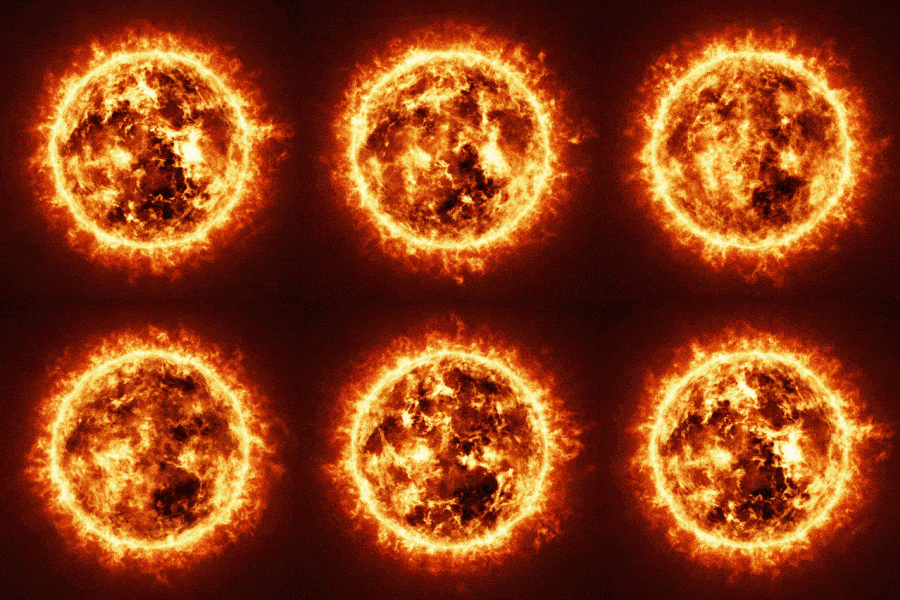
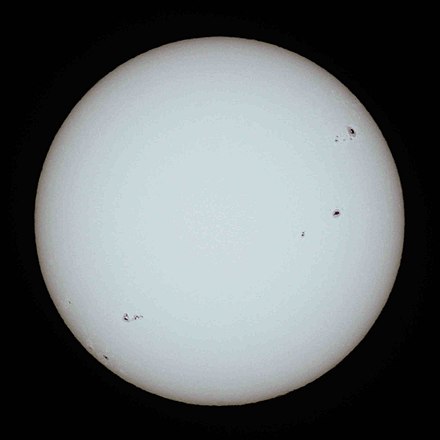
The Sun is the star at the center of the Solar System. It is a nearly perfect sphere of hot plasma,[14][15] with internal convective motion that generates a magnetic field via a dynamo process.[16]
It is by far the most important source of energy for life on Earth. Its diameter is about 1.39 million kilometers, or 109 times that of Earth, and its mass is about 330,000 times that of Earth.
Total mass
It accounts for about 99.86% of the total mass of the Solar System.[17] About three quarters of the Sun's mass consists of hydrogen (~73%); the rest is mostly helium (~25%), with much smaller quantities of heavier elements, including oxygen, carbon, neon, and iron.[18]
Sun with sunspots and limb darkening as seen in visible light with solar filter.
A star
The Sun is a G-type main-sequence star (G2V) based on its spectral class. As such, it is informally and not completely accurately referred to as a yellow dwarf (its light is closer to white than yellow). It formed approximately 4.6 billion[a][10][19] years ago from the gravitational collapse of matter within a region of a large molecular cloud.
The enormous effect of the Sun on Earth has been recognized since prehistoric times, and the Sun has been regarded by some cultures as a deity. The synodic rotation of Earth and its orbit around the Sun are the basis of solar calendars, one of which is the predominant calendar in use today.
A black hole is a region of spacetime exhibiting such strong gravitational effects that nothing—not even particles and electromagnetic radiation such as light—can escape from inside it.[1] The theory of general relativity predicts that a sufficiently compact mass can deform spacetime to form a black hole.[2][3]
The boundary of the region from which no escape is possible is called the event horizon. Although the event horizon has an enormous effect on the fate and circumstances of an object crossing it, no locally detectable features appear to be observed.[4]
Quantum field
In many ways a black hole acts like an ideal black body, as it reflects no light.[5][6] Moreover, quantum field theory in curved spacetime predicts that event horizons emit Hawking radiation, with the same spectrum as a black body of a temperature inversely proportional to its mass. This temperature is on the order of billionths of a kelvin for black holes of stellar mass, making it essentially impossible to observe.
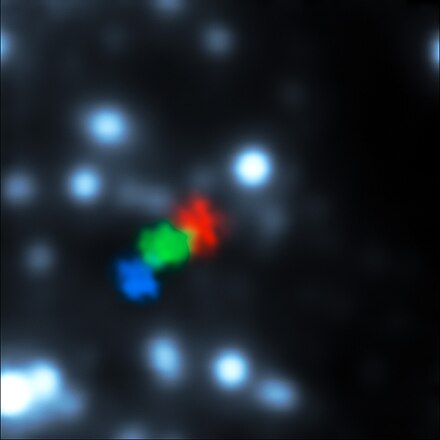
Gas cloud being ripped apart by black hole at the centre of the Milky Way (observations from 2006, 2010 and 2013 are shown in blue, green and red, respectively).[11]
Gravitational fields
Objects whose gravitational fields are too strong for light to escape were first considered in the 18th century by John Michell and Pierre-Simon Laplace.[7]
The first modern solution of general relativity that would characterize a black hole was found by Karl Schwarzschild in 1916, although its interpretation as a region of space from which nothing can escape was first published by David Finkelstein in 1958. Black holes were long considered a mathematical curiosity; it was during the 1960s that theoretical work showed they were a generic prediction of general relativity. The discovery of neutron stars in the late 1960s sparked interest in gravitationally collapsed compact objects as a possible astrophysical reality.
A star is type of astronomical object consisting of a luminous spheroid of plasma held together by its own gravity. The nearest star to Earth is the Sun.
Many other stars are visible to the naked eye from Earth during the night, appearing as a multitude of fixed luminous points in the sky due to their immense distance from Earth.
Historically
Historically, the most prominent stars were grouped into constellations and asterisms, the brightest of which gained proper names. Astronomers have assembled star catalogues that identify the known stars and provide standardized stellar designations.
False-color imagery of the Sun, a G-type main-sequence star, the closest to Earth
Telescopes
However, most of the stars in the Universe, including all stars outside our galaxy, the Milky Way, are invisible to the naked eye from Earth. Indeed, most are invisible from Earth even through the most powerful telescopes.
For at least a portion of its life, a star shines due to thermonuclear fusion of hydrogen into helium in its core, releasing energy that traverses the star's interior and then radiates into outer space.
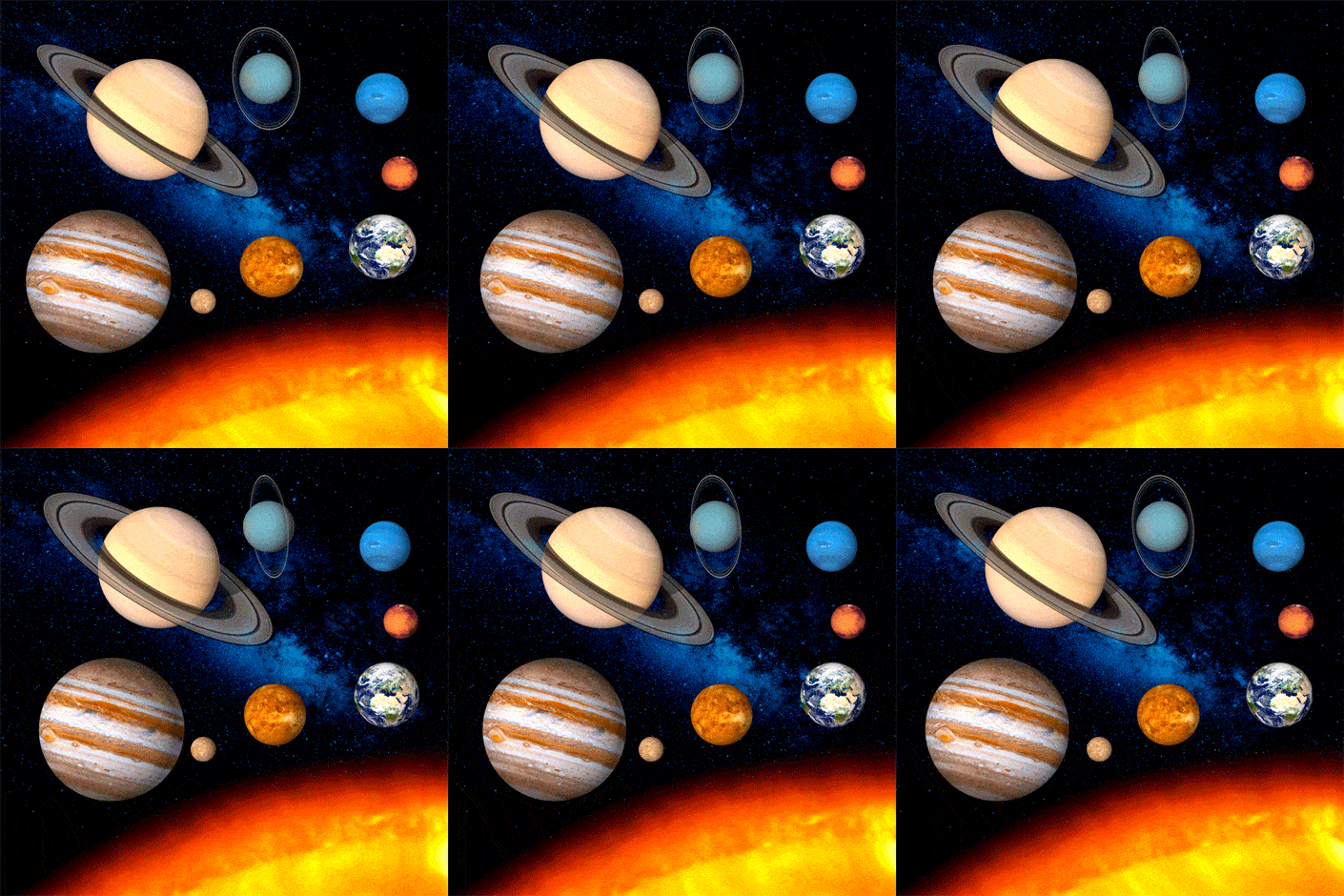
A planet is an astronomical body orbiting a star or stellar remnant that is massive enough to be rounded by its own gravity, is not massive enough to cause thermonuclear fusion, and has cleared its neighbouring region of planetesimals.[a][1][2]
The term planet is ancient, with ties to history, astrology, science, mythology, and religion. Five planets in the Solar System are visible to the naked eye.
The idea
The idea of planets has evolved over its history, from the divine lights of antiquity to the earthly objects of the scientific age. The concept has expanded to include worlds not only in the Solar System, but in hundreds of other extrasolar systems. The ambiguities inherent in defining planets have led to much scientific controversy.
Printed rendition of a geocentric cosmological model from Cosmographia, Antwerp, 1539
Naked eye
The five classical planets, being visible to the naked eye, have been known since ancient times and have had a significant impact on mythology, religious cosmology, and ancient astronomy.
The first civilization known to have a functional theory of the planets were the Babylonians, who lived in Mesopotamia in the first and second millennia BC. The oldest surviving planetary astronomical text is the Babylonian Venus tablet of Ammisaduqa, a 7th-century BC copy of a list of observations of the motions of the planet Venus, that probably dates as early as the second millennium BC.
Dark matter is a hypothetical form of matter that is thought to account for approximately 85% of the matter in the universe, and about a quarter of its total energy density. The majority of dark matter is thought to be non-baryonic in nature, possibly being composed of some as-yet undiscovered subatomic particles.[note 1]
The name dark matter refers to the fact that it does not appear to interact with observable electromagnetic radiation, such as light, and is thus invisible (or 'dark') to the entire electromagnetic spectrum, making it extremely difficult to detect using usual astronomical equipment.[1]
First to suggest
The first to suggest the existence of dark matter, using stellar velocities, was Dutch astronomer Jacobus Kapteyn in 1922.[21][22] Fellow Dutchman and radio astronomy pioneer Jan Oort also hypothesized the existence of dark matter in 1932. Oort was studying stellar motions in the local galactic neighborhood and found that the mass in the galactic plane must be greater than what was observed, but this measurement was later determined to be erroneous.[25]
Simulated Large Hadron Collider CMS particle detector data depicting a Higgs boson produced by colliding protons decaying into hadron jets and electrons
Fritz Zwicky
n 1933, Swiss astrophysicist Fritz Zwicky, who studied galaxy clusters while working at the California Institute of Technology, made a similar inference.[26][27][28] Zwicky applied the virial theorem to the Coma Cluster and obtained evidence of unseen mass that he called dunkle Materie ('dark matter').
The first robust indications that the mass-to-light ratio was anything other than unity came from measurements of galaxy rotation curves. In 1939, Horace W. Babcock reported the rotation curve for the Andromeda nebula (known now as the Andromeda Galaxy), which suggested that the mass-to-luminosity ratio increases radially.[31] He attributed it to either light absorption within the galaxy or modified dynamics in the outer portions of the spiral and not to missing matter.
Family discovering exciting exhibit
The ISM - Interactive Science Musem has a long standing history of fun interactive ways of learning about science and history. The Museum features exhibits from Ancient Legends to Dinosaurs, Outer space, Robots and much more.
Exhiting events
The Musem gathers high praise and recognition internationally, and attracts several well known professors to lecture on subjects relevant to the sections of the Museum. You are destined to learn something new by following along these exhiting weekly lectures.
For all ages
We accomodate eager students to fresh preschoolers, and also have alot of senior visitors. In short, the museum is open for all and is sure to provide everyone with something suited for their interests and needs. The museum also has easy access for wheel
chairs and several toilets fr the needy.
Caféteria
If you're hungry you can always grab a bite in our interactive caféteria, it even features it's own Virtual reality setup if you eat faster than your friends and don't like waiting.
 +
+ +
+ +
+





 If you're hungry you can always grab a bite in our interactive caféteria, it even features it's own Virtual reality setup if you eat faster than your friends and don't like waiting.